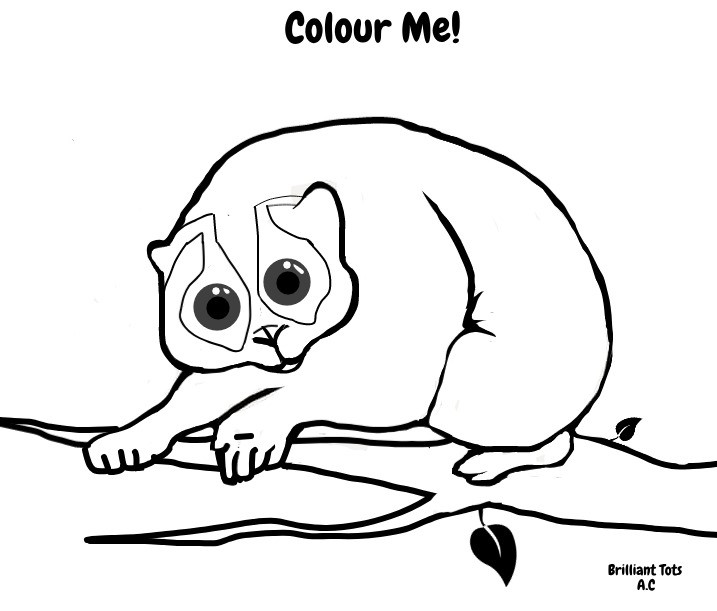
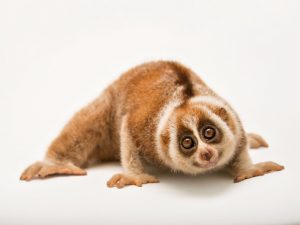
Today on Wildlife Wednesdays, we will be taking a look into the life of a Slow Loris.
Are you guys ready for an exciting expedition?!
Let’s go to Brilliant Explorers!
Just like their names, these creatures are slow-paced, which means they move very slowly, just like a sloth. A Slow Loris is a mammal that belongs to the primate family.
What is a mammal?
- A mammal has fur or hair
- A mammal is warm-blooded – warm-blooded animals can make their own body heat even when surrounding temperatures are cold, and they can cool down in hot temperatures, warm-blooded animals can maintain constant body temperatures in any weather.
- Mammals can produce milk, and they also drink milk from their mothers when they are babies
- Mammals have vertebrates; a vertebrate is the backbone of an animal
- Mammals breathe in oxygen
What is a primate?
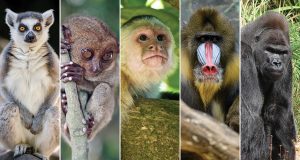
- Primates are a group of intelligent mammals; there are more than 300 types of primates.
- Apes, monkeys, lemurs, and lorises are some examples of animals that are in the primate family
- Primates come in all shapes and sizes, from the small capuchin monkey to the mighty gorilla.
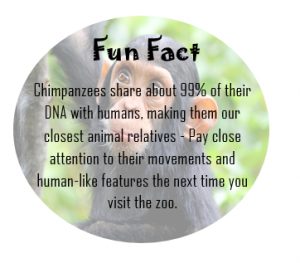
- Most primates have thumbs that can bend, just like us! – It makes it easier for them to grasp things with their human-like hands.
- Primates tend to have large brains when compared to the size of their bodies
- Primates are usually covered in hair
Now that we have covered the basics of mammals and primates let’s get back to our furry little friend, the slow loris.
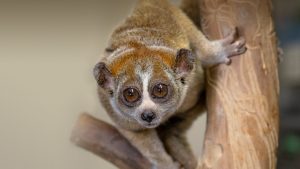
The slow loris has adorable beady eyes that help them see better in the dark. Slow lorises are nocturnal animals, and because there is little to no light at night, their eyes work as ‘night-vision goggles, and they can easily find their way through the darkness.
What does nocturnal mean?
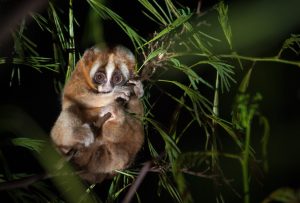
The word nocturnal itself means active at night, nocturnal animals are awake throughout the nights and asleep during the day.
These furry primates can be found in the regions of Southeast Asia. The Sunda Slow Loris, also known as the Greater Slow Loris, call the jungles of Malaysia, Singapore, Thailand, and The Philippines their home. Try and spot our slow furry friends the next time you go jungle trekking.
What do they eat?
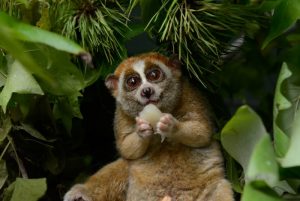
Slow Lorises are omnivorous; their diet consists of insects, nectar, fruits, eggs, small reptiles, and even small birds.
Herbivorous = Veggie eaters (They eat plants)
Carnivorous = Meat eaters (They eat other animals)
Omnivorous = They eat both meat and veggies (They eat plants and other animals or insects)
Slow Lorises have long tongues, similar to that of a hummingbird; they use their long tongues to slurp nectar from flowers.
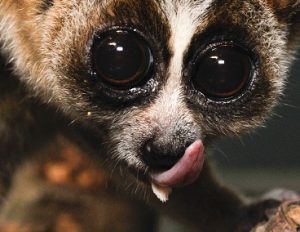
Cute but venomous!
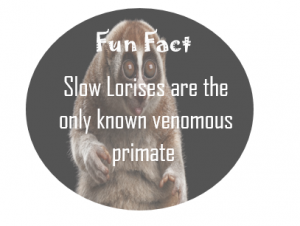
This is what makes the slow loris such a fascinating animal, their cuteness and slow pace covers up the fact that the slow loris is actually a venomous mammal!
What is a venomous animal?
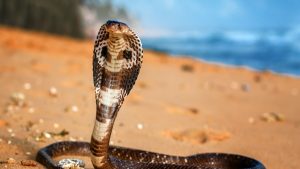
A venomous animal is one that bite or sting to inject their venom (a poisonous substance). Venomous animals use venomous bite or sting only when they are in danger and to protect themselves from harm or to hunt their prey. Some animals are deadly venomous – King Cobras, Blue-Ringed Octopus, Box Jellyfish. Other animals are not venomous enough to kill humans but can take down smaller prey and used when attacked – Just like our little furry friend, the slow loris.
When a slow loris feels threatened, their first instinct is to lift their arms over their head; covering their face; this is their defense posture. In Indonesia, our furry friends are called ‘malu malu’ which means shy because of how they stay still and cover their faces with their hands.
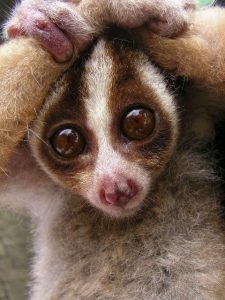
Slow lorises have a gland under their arms, which secretes toxic venom. Because of their defense posture, it makes it easier for the slow loris to reach the gland, the slow loris will lick the gland, which will cover their teeth in the venom. If a predator gets too close, the slow loris will bite down, releasing the venom into the bite’s wound. A slow loris has sharp canine teeth that can easily cut through the skin. Their venom is not strong enough to kill a human; however, it leads to serious harm; it causes an allergic reaction that makes the body painfully swell.
What are canine teeth?
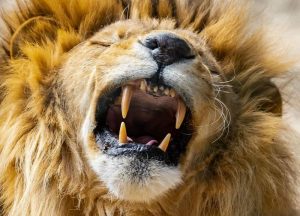
Canine teeth are the longest and sharpest teeth found in the mouth. Herbivores do not have canine teeth, but carnivores and omnivores do to help them cut through tough meat. Humans have canine teeth as well. Can you find the canine teeth on the Lion?
The wildlife trade
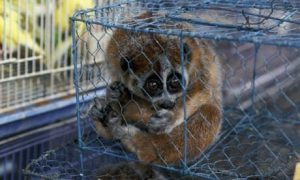
Because of how cute they are, these poor animals are taken from their natural habitat and are kept as pets, where they do not belong. They are sold as pets all over the world. If you walk the streets of Thailand and Indonesia, our furry friends are used as a tourist attraction for people to take pictures with a cute animal. Most times, their canine teeth will be pulled out to prevent the handler and tourists from getting bitten; the same happens when they are kept as pets. Our furry friends are kept in poor conditions and are away from their families.
Do our part as Brilliant Explorers!
As Brilliant Explorers, we help animals in need as we learn about the world of wildlife. If you ever see a slow loris being used as a tourist attraction, don’t take pictures with it, boycott it. Tell your friends about what you learned and get them to boycott the illegal wildlife trade as well. If you see aa slow loris being sold in a pet shop, used as a tourist attraction or kept as a pet, get mom or dad to report it to your local WWF. Let’s do our parts as Brilliant Explorers, even the smallest of steps can save lives and make this world a better place.